Anna Schmidt · 4 September 2026
How Automation Streamlines Note Organization in Digital Workflows
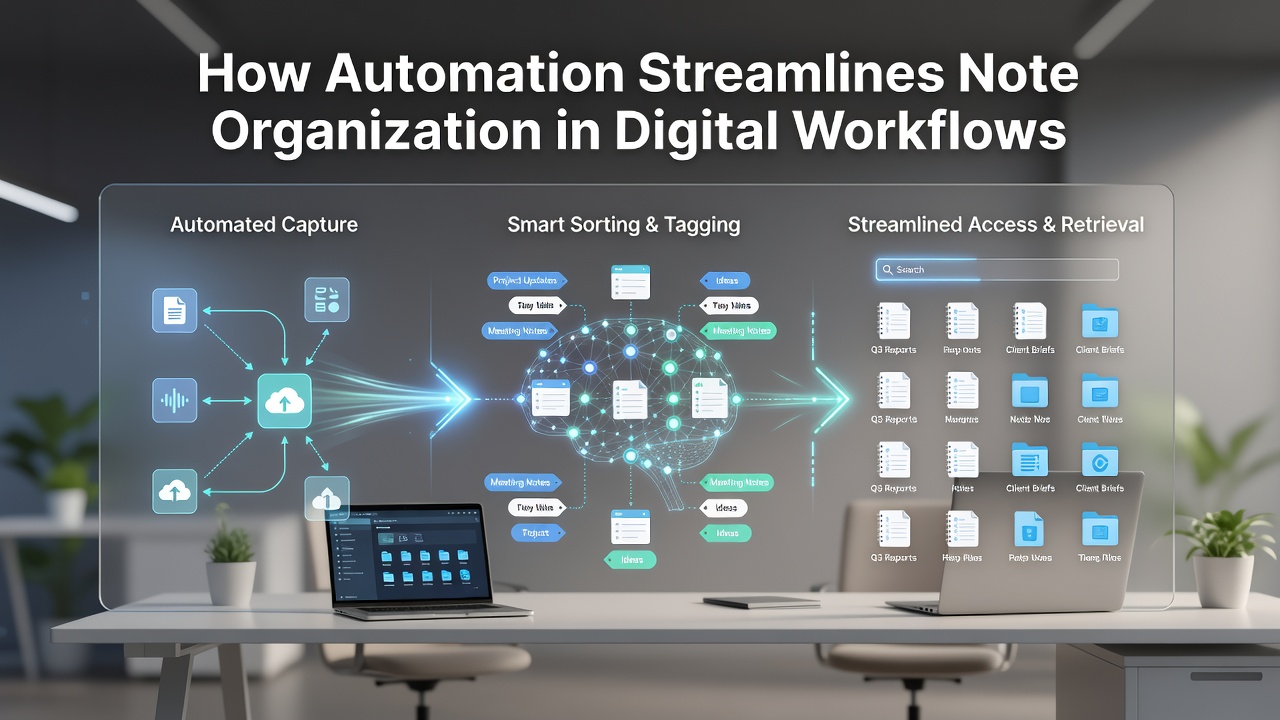
Automation tools handle note organization by applying rules and machine learning models that tag content, sort entries, and link related items without manual input from users. Researchers at institutions across multiple regions have documented how these systems reduce the time spent on filing and retrieval tasks, with data from productivity studies showing measurable decreases in administrative overhead for knowledge workers.
Core Mechanisms Behind Automated Organization
Systems scan incoming notes for keywords, dates, and contextual signals then assign categories automatically, while natural language processing identifies themes and creates cross-references between documents. Observers note that integration with calendar applications and email clients allows timestamps and participant lists to populate metadata fields directly, and this process eliminates duplicate entries that often arise in manual systems. Data from enterprise deployments indicates that such linkages improve search accuracy by connecting notes to project timelines and team communications in real time.
Rules-based engines trigger actions based on predefined conditions, such as routing meeting summaries to specific folders when certain attendees appear, whereas machine learning components adapt over repeated use by learning individual patterns without requiring constant reprogramming. Those who manage large archives report that these adaptive features maintain consistency across thousands of entries, and updates rolled out in September 2026 expanded compatibility with additional third-party platforms used in research and education sectors.
Integration With Existing Digital Ecosystems
Workflow platforms connect to task management software so that notes attached to projects receive priority labels derived from deadline data, and this connection allows status changes in one application to propagate organization changes elsewhere. Studies conducted by Canadian academic groups have tracked how these connections support distributed teams by surfacing relevant materials during collaborative sessions, while reports from European research networks highlight similar gains in sectors where regulatory documentation requires frequent updates.
Cloud synchronization ensures that automated classifications remain consistent across devices, and backup protocols preserve version histories that automation scripts can reference when reorganizing older material. Figures from industry analyses reveal that organizations adopting these integrated setups experience fewer instances of misplaced files, particularly when staff transition between devices throughout the workday.

Measured Impacts on Retrieval and Collaboration
Search functions enhanced by automation return results ranked by relevance rather than simple keyword matches, and this ranking draws from usage patterns and content relationships established during initial processing. According to a University of Melbourne study on digital productivity tools, teams using automated systems located archived information faster than those relying on manual folders, and the same research noted reduced duplication of effort when multiple contributors accessed shared repositories.
Collaboration features allow automated summaries to generate from threaded discussions, with key points extracted and stored alongside source materials for later reference. Data compiled by the OECD on workplace digitalization shows that such summarization tools correlate with shorter meeting follow-up times, since participants receive organized recaps without additional administrative steps. Those managing remote teams often find that automated version tracking prevents conflicts when several users edit the same note simultaneously.
Implementation Patterns Across Sectors
Healthcare providers apply automation to categorize patient notes by diagnosis codes and appointment dates, which streamlines compliance reviews without requiring clinicians to perform extra filing steps. Educational institutions use similar processes to sort lecture materials and assignment feedback by course modules, and government agencies in Australia have reported streamlined record-keeping after deploying automated tagging for policy documents. Each sector adapts the core technology to its specific metadata requirements while maintaining the same underlying automation logic.
Training programs teach users how to set initial rules and review automated suggestions, yet ongoing adjustments typically decrease as systems learn from corrections. Reports indicate that initial setup time varies by organization size, but long-term maintenance remains low once classification models stabilize.
Conclusion
Automation in note organization operates through consistent application of tagging, linking, and search enhancement across connected platforms, and evidence from multiple studies confirms efficiency gains in retrieval speed and collaboration support. Continued development, including updates observed in September 2026, extends these capabilities to new software environments while preserving the factual benefits already documented in productivity data. Organizations evaluating these tools can reference reports from sources such as the OECD digital economy work and academic analyses from the University of Toronto for implementation benchmarks.